
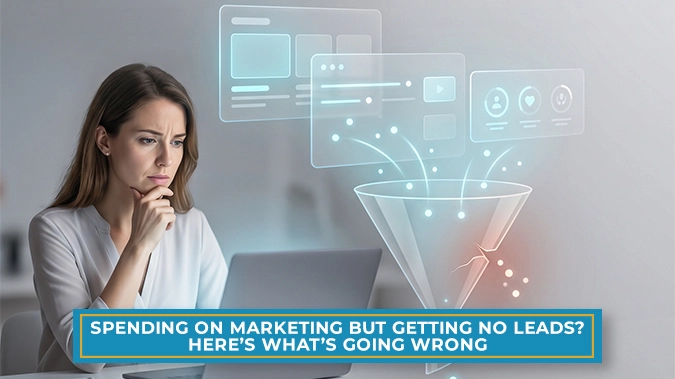
Spending on Marketing but Getting No Leads? Here’s What’s Going Wrong
Many businesses invest heavily in marketing but struggle to turn traffic into qualified leads. This blog uncovers the most common reasons behind poor lead generation, from targeting and messaging issues to weak conversion funnels. Learn how to identify hidden gaps, improve marketing performance, and create a strategy that drives meaningful business growth.
Overview: If you are spending on marketing but not getting leads, the issue is often not your budget but the gaps in your targeting, messaging, website, or conversion process. Successful lead generation comes from aligning your audience, messaging, website, and marketing funnel, not simply increasing your marketing spend.
Key Takeaways
- Wrong audience targeting leads to low-quality traffic.
- Poor website experience reduces conversions.
- Missing funnel strategy causes lead drop-offs.
- Generic messaging fails to address customer needs.
- Weak SEO attracts traffic without intent.
- Vanity metrics can hide real performance issues.
- Better CTAs and landing pages improve lead generation.
- Continuous optimization drives stronger marketing ROI.
You are running ads, investing in SEO, posting content, maybe even hiring agencies. Traffic is coming in, dashboards look active, but there is one problem that doesn’t go away, that is there are no leads, no inquiries, no conversions.
This is one of the most common challenges businesses face today. The issue usually isn’t that marketing doesn’t work. It’s that something in the system between traffic and conversion is broken.
Marketing is no longer just about visibility. It is about turning attention into action. And if that connection is missing, even high budgets won’t bring results. In this blog post, we will explore the facts where the businesses are actually going wrong.
You’re Talking to People Who Were Never Likely to Buy
One of the most common reasons for poor lead generation starts right at the targeting stage. Many campaigns are built to reach “more people” instead of the “right people.”
When targeting is too broad, your message gets shown to users who may be interested in the topic, but not necessarily ready to take action. They might browse, compare, or leave without engaging further.
The problem is not volume. It is relevant. Strong campaigns are built around intent, not just reach. This is where strategies, like SEO services for lead generation become important, because they focus on attracting users who are already searching with a purpose. The closer you get to identifying who actually needs your service right now, the higher your chances of conversion become.
Your Website Is Getting Visits, But Not Holding Attention
A website often creates the first real impression of your business, and users decide very quickly whether to stay or leave. If they land on a page and feel confused, distracted, or uncertain, they don’t wait around.
In many cases, the issue is not obvious errors, but small friction points. Maybe the message doesn’t clearly explain what you do. Maybe the page takes too long to load. Or maybe the next step is not obvious.
A good website does not try to impress. It tries to guide. It should quietly lead a visitor from curiosity to clarity, and then to action without forcing it. If you are seeing visits but no enquiries, it is worth reviewing why your website traffic is not converting into leads and identifying where users drop off.
Traffic Without a Journey Doesn’t Create Leads
Getting traffic is only the starting point. What happens after that decides whether marketing actually works. Many businesses miss the importance of a proper journey. A user might discover you today and never hear from you again. This is where the funnel breaks.
- Awareness is created, but not nurtured
- Interest is generated, but not followed up
- Visitors are not retargeted or re-engaged effectively
Without structured touch-points, even good traffic loses momentum. People don’t convert because they forget, not because they are uninterested. This is why frameworks like content marketing funnel strategies are essential for turning attention into structured conversions.
Your Messaging Isn’t Solving a Real Problem
Messaging is where most businesses unintentionally weaken their own marketing. Instead of addressing real problems, communication often becomes too generic or internally focused. Users don’t respond to “we provide solutions.” They respond when they feel understood.
A strong message usually reflects:
- The actual pain point the customer is facing
- The outcome they are trying to achieve
- The hesitation that is stopping them from deciding
This is also where structured approaches like conversion rate optimization strategies help refine messaging into something that actually drives action.
You Might Be Tracking Activity, Not Outcomes
Another hidden issue is measurement. Many businesses evaluate success using metrics that feel positive but don’t reflect business growth. It is easy to get impressed by impressions, clicks, and engagement. But those numbers don’t always translate into leads. What actually matters more is:
- Cost per lead (CPL)
- Conversion rate from landing pages
- Quality of inbound enquiries
- Funnel drop-off points
Without tracking these properly, marketing decisions are made on incomplete signals. A clearer performance approach, often used in performance marketing services, focuses on measurable outcomes instead of surface-level activity.
You’re Getting Traffic, But Not the Right Traffic
SEO and content marketing often bring volume, but not always relevance. This is where things get misleading. A page might rank well, get clicks, and still produce no leads. Common issues include:
- Ranking for informational keywords instead of transactional intent
- Content that explains but doesn’t guide action
- Lack of topic depth that builds authority in one direction
This is where comparing approaches like SEO vs PPC for lead generation becomes useful, because intent-driven traffic often converts better than broad visibility campaigns.
What Usually Helps Fix Lead Generation Quickly
The good news is that most lead problems are not permanent. They are usually structural and can be improved with focused changes. Here are some practical improvements that often show fast impact:
- Landing page clarity: Simplify messaging so users immediately understand value
- Stronger CTAs: Make the next step obvious without overwhelming the user
- Retargeting setup: Bring back visitors who didn’t convert the first time
- Intent-based keywords: Shift focus from traffic keywords to action-driven queries
- Lead magnets: Offer something valuable in exchange for contact details
These are not big overhauls. But together, they improve how efficiently your system converts attention into leads.
When Strategy Matters More Than Execution
There comes a point where tweaking small elements is not enough. If traffic is consistent but conversions remain weak, the problem is usually strategic, not tactical. This is when it helps to step back and evaluate:
- Is the audience aligned with the offer?
- Is the funnel actually guiding users forward?
- Is messaging consistent across all touchpoints?
A performance-focused approach that connects SEO, paid ads, landing pages, and funnels supported by digital marketing services often reveals gaps that are not visible in isolated campaigns. That’s usually where real growth starts unlocking.
The Bottom Line
Marketing rarely fails because of lack of effort. It fails because of disconnects in the system. The audience is not clearly defined, the message is not sharp enough, or the funnel is not guiding users properly. Once these gaps are identified, improvements become much more predictable.
If your marketing is bringing traffic but not leads, the answer is not more spending. It is about better alignment.
Not getting leads from your marketing campaigns? Let’s identify what’s blocking your conversions and build a strategy that actually drives results.
FAQs:
- Why am I getting traffic on my website but no leads?
Getting traffic doesn’t automatically mean people are ready to buy. In most cases, users are either in research mode or your website isn’t guiding them clearly toward the next step. If the intent, messaging, or conversion flow is weak, visitors leave without taking action.
- What are the most common reasons marketing campaigns fail to generate leads?
The most common issues include targeting the wrong audience, unclear messaging, weak landing pages, and missing follow-up systems. Many campaigns focus on clicks and impressions but fail to connect the full journey from interest to conversion.
- How do I improve my lead conversion rate without increasing ad spend?
Start by improving what already exists. Fix your landing pages, simplify your call-to-actions, and ensure your messaging speaks directly to customer pain points. Adding retargeting campaigns and lead capture forms can also significantly improve conversions without increasing budget.
- Is SEO enough to generate leads for my business?
SEO helps bring visibility and traffic, but leads depend on intent and conversion structure. If your content is not aligned with buyer intent or your website doesn’t convert well, even high rankings won’t bring consistent enquiries.
- Why do ads bring clicks but no enquiries?
This usually happens when targeting is too broad or the landing page doesn’t match what the ad promises. Users expect consistency. If there is a disconnect between ad message and page experience, they leave without converting.
- How do I know if my marketing funnel is broken?
If users are visiting your website but not taking actions like filling forms, calling, or signing up, your funnel likely has gaps. It could be missing follow-ups, unclear messaging, or weak landing page structure.
- When should a business consider professional help for lead generation?
If you are consistently spending on marketing but not seeing qualified leads or ROI, it is a strong sign your strategy needs expert review. A performance-focused audit can help identify where exactly the breakdown is happening in your funnel.