
How to Optimize Paid Campaigns for Revenue Instead of Clicks
Your ad campaign is getting clicks. The CTR looks healthy, CPC is under control, and traffic is moving in the right direction. But there is one question that matters more than all of these numbers,” Is the campaign actually generating revenue?”
Clicks are an important part of the advertising journey, but they are not the destination. A visitor needs to become a lead, a qualified prospect, a customer, and, ultimately, a source of revenue before those clicks create real business value.
That is why businesses are increasingly shifting from click-focused PPC optimization towards revenue-focused advertising. The goal is not simply to get more people to click. It is to make every advertising decision closer to the commercial outcome that the business actually wants.
Why Optimizing Paid Campaigns for Clicks Is Not Enough
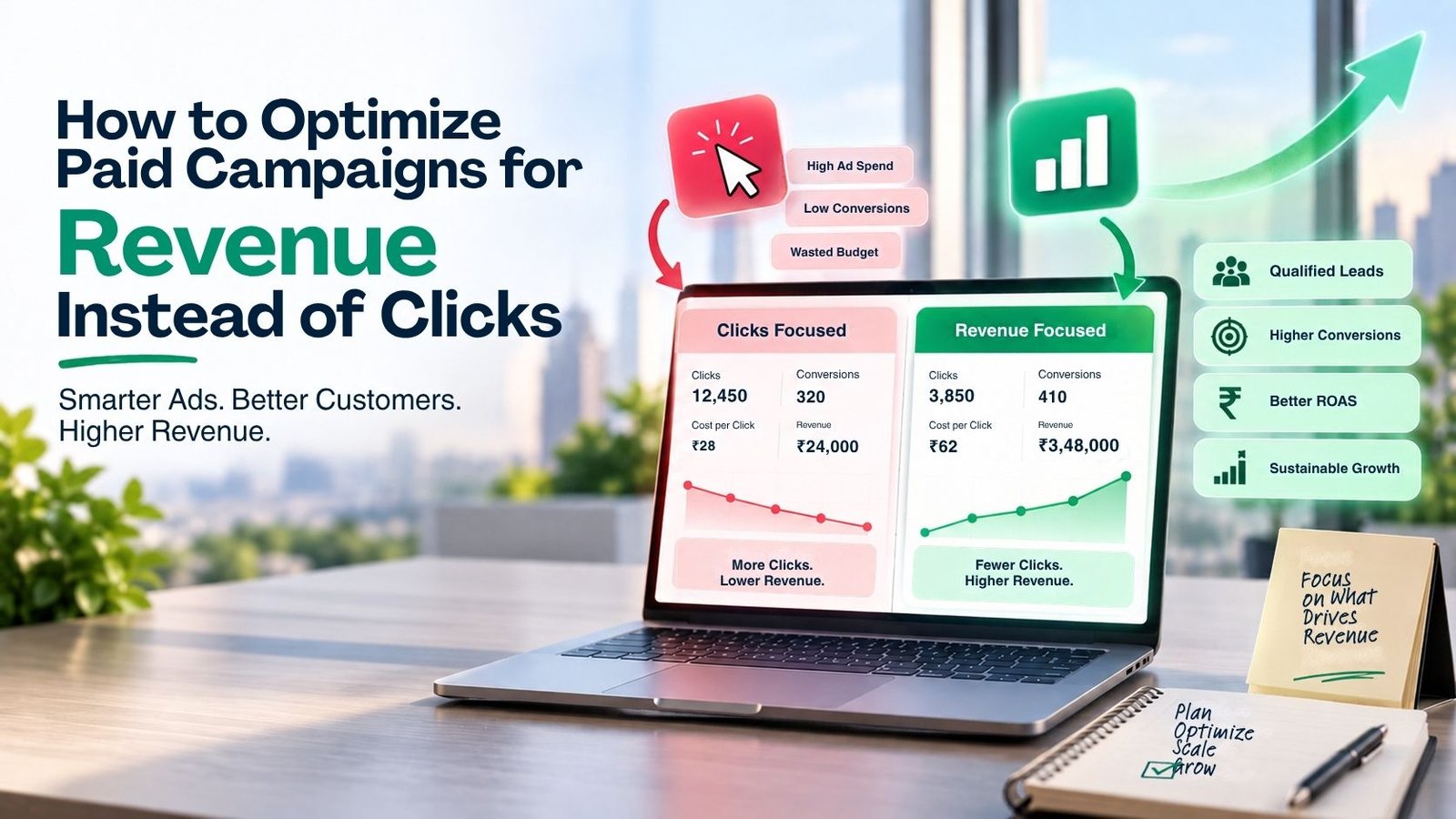
Imagine two campaigns. One generates 2,000 clicks but very few customers. Another generates 800 clicks and produces several high-value sales.
If you only look at traffic, the first campaign appears stronger. If you look at revenue, the picture could be completely different.
A better way to view the funnel is:
Impressions → Clicks → Leads → Qualified Leads → Customers → Revenue
Each stage tells you something different. Clicks indicate interest. Conversions show action. Qualified leads indicate stronger buying potential, while customers and revenue reveal the commercial outcome.
Google Ads itself distinguishes between conversion volume and conversion value, with value-based bidding designed to optimize towards the value a business receives rather than simply the number of conversions.
What Does Revenue-Focused Paid Advertising Mean?
Revenue-focused PPC means making campaign decisions based on what contributes to business growth, not just what improves advertising-platform metrics.
So, “How can we get more clicks?” is no longer the only concern for businesses. Now, the questions become:
- Which campaigns generate qualified customers?
- Which conversions are actually valuable?
- How much revenue does each campaign generate?
- What does it cost to gain a customer’s genuine attention?
- Which audiences produce higher-value customers?
This approach connects media performance with the wider sales funnel, giving marketing teams a more useful view of where their advertising budget is going.
10 Ways to Optimize Paid Campaigns for Revenue
1. Set Revenue-Based Campaign Objectives
Start with the business outcome. If the objective is sales, subscriptions or qualified opportunities, make sure campaign goals and conversion actions reflect those outcomes instead of relying heavily on clicks or other upper-funnel actions.
2. Track Real Conversions Instead of Surface-Level Actions
Not every action deserves to be treated as a success. A form submission, product purchase, qualified lead or closed deal can have very different business values.
Your tracking should distinguish between these actions so optimization is based on meaningful conversions.
3. Optimize for Qualified Leads, Not Just Lead Volume
For B2B and high-consideration businesses, Qualified Lead Generation is often more valuable than simply increasing the number of leads.
Google Ads now supports conversion goals for qualified leads and converted leads, allowing advertisers to use offline data to identify where leads progress through the sales journey.
4. Use High-Intent Keywords and Audiences
Not every search or audience signal carries the same buying intent. Review the queries, audiences and placements producing actual customers, then prioritize the sources that align with your commercial goals.
For search campaigns, this also means regularly reviewing search terms and using negative keywords where irrelevant traffic is consuming the budget.
5. Assign Accurate Conversion Values
If every conversion is treated equally, the advertising platform has limited information about which outcomes matter more.
Assigning meaningful values allows you to distinguish between low-value and high-value conversions. Google Ads notes that conversion values can help advertisers measure business impact and optimize towards higher-value conversions.
6. Optimize Bids Based on Conversion Value
Once reliable conversion values are available, value-based bidding can help align bidding with business value.
Google Ads' Maximize conversion value and Target ROAS strategies are designed to optimize towards conversion value rather than simply maximizing conversion volume.
The key is to get the conversion data right first. AI can optimize towards the signals you provide, but it cannot fix a business goal that has been poorly defined.
7. Improve Landing Page Conversion Rates
Getting the right visitor to the website is only half the job. The landing page needs to make the next step clear.
Review the message match between the ad and landing page, page speed, mobile experience, forms, pricing information, trust signals and calls to action. Small improvements after the click can influence how much value you get from the traffic you already paid for.
8. Use First-Party Data to Improve Targeting
Your CRM and customer database can reveal which customers are actually valuable. Use this first-party information to understand customer segments, repeat purchases, lead quality and buying behaviour where your privacy and platform requirements allow.
This can help move optimization beyond anonymous clicks towards known customer outcomes.
9. Continuously Test Ads and Offers
Revenue-focused optimization is not a one-time exercise. Test different messaging, creative formats, offers, landing pages and audience approaches.
But do not judge every test only by CTR. A variation with fewer clicks can still be more commercially useful if it attracts better customers.
10. Connect Advertising Data with CRM and Sales Data
This is particularly important for businesses where the sale happens after the initial lead.
Offline conversion tracking can connect advertising interactions with later outcomes such as qualified leads or sales. Google Ads supports importing offline conversion information and using it for optimization, helping bridge the gap between an online ad interaction and an offline business outcome.
How Google Ads Can Be Optimized for Revenue
For Google Ads, revenue-focused optimization starts with accurate conversion tracking and meaningful conversion values.
Search campaigns can use keyword and search-term data to understand intent, while Smart Bidding can use machine learning to adjust bids at auction time. Google describes Smart Bidding strategies such as Target CPA, Target ROAS, Maximize conversions and Maximize conversion value as tools aligned with different business objectives.
For businesses with different customer values, conversion value rules can also help account for differences such as audience, location or other business-defined value factors.
Performance Max can also form part of a revenue-focused strategy when the underlying conversion signals and values are reliable.
How Meta Ads Can Be Optimized for Revenue
The same principle applies to Meta Ads. Instead of judging campaigns mainly by clicks or engagement, businesses should connect campaigns to the conversion events that represent their actual objectives.
Creative testing, audience signals, retargeting, conversion data, and automated optimization can then be evaluated against outcomes such as purchases, qualified leads, or customer value.
The important point is consistency: whether the campaign runs on Google, Meta, or another platform, the optimization goal should ultimately connect back to the business outcome.
How AI Helps Optimize Paid Campaigns for Revenue
AI is changing how Paid Campaign Optimization is managed, particularly through automated bidding, predictive modelling, audience signals, creative testing, and budget optimization.
Google's Smart Bidding, for example, uses machine learning and auction-time signals to optimize bids towards conversions or conversion value.
But AI is not a substitute for strategy. If the campaign is tracking every form filled as equally valuable when only a small percentage become customers, automation may simply optimize towards the wrong outcome faster.
Better data + clearer goals + AI-driven optimization = a stronger foundation for revenue-focused campaigns.
Which Paid Advertising Metrics Actually Matter for Revenue?
No single metric tells the whole story. Depending on the business model, monitor:
|
Metric |
What it tells you |
|
CTR |
How often people click after seeing an ad |
|
CPC |
How much each click costs |
|
Conversion Rate |
How efficiently traffic takes the desired action |
|
CPA / CAC |
What it costs to acquire a conversion or customer |
|
CPL |
Cost of generating a lead |
|
Qualified Lead Rate |
How many leads meet your quality criteria |
|
ROAS |
Revenue generated relative to ad spend |
|
CLV |
Potential value of a customer over their relationship with the business |
|
Revenue per Customer |
Average revenue generated by acquired customers |
|
Profit Margin |
How much revenue remains after relevant costs |
These metrics become more useful when viewed together rather than in isolation.
How to Connect PPC Data With Business Revenue
The missing link for many businesses is what happens after the form submission.
Connect advertising platforms with your CRM or sales systems wherever practical. Track when a lead becomes qualified, enters the sales pipeline, becomes an opportunity and eventually becomes a customer.
This gives marketing teams a feedback loop between advertising and sales. Google also supports CRM and offline conversion workflows that can send later customer outcomes back into advertising systems for measurement and optimisation.
Click-Focused PPC vs Revenue-Focused PPC
|
Click-Focused PPC |
Revenue-Focused PPC |
|
Prioritises traffic volume |
Prioritises business outcomes |
|
Focuses heavily on CTR and CPC |
Looks at revenue, ROAS, CAC and customer value |
|
Measures online actions |
Connects online and offline outcomes |
|
Treats conversions similarly |
Differentiates conversion value |
|
Optimises for more activity |
Optimises for more valuable activity |
|
Reports mainly on ad-platform data |
Connects marketing data with CRM and sales data |
The shift is not about ignoring clicks. It is about putting them in the right place within the bigger picture.
Common Mistakes That Prevent Paid Campaigns From Generating Revenue
Some of the most common problems are surprisingly basic:
- Optimising for cheap clicks instead of valuable customers
- Treating every lead as equally valuable
- Using incorrect or incomplete conversion tracking
- Sending traffic to weak or poorly matched landing pages
- Targeting audiences without considering buying intent
- Ignoring customer lifetime value
- Looking only at platform-reported conversions
- Failing to connect marketing data with sales outcomes
Fixing the measurement foundation can often be just as important as changing the campaign settings.
A Revenue-Focused PPC Optimisation Framework
A practical framework can look like this:
Business goal → Conversion tracking → Audience → Offer → Campaign → Optimisation → CRM → Revenue analysis → Continuous improvement
Start with what the business wants to achieve. Define the conversions that represent progress towards that goal, assign value where appropriate, connect the data with sales outcomes and then use campaign performance to make the next optimisation decision.
This creates a cycle rather than a one-off campaign setup.
When Should You Hire a Performance Marketing Agency?
External expertise can become useful when paid campaigns are becoming difficult to manage or the connection between advertising spend and revenue is unclear. In such cases, PPC Management Services can help businesses bring campaign strategy, tracking, optimisation and revenue analysis together.
Common signs include rising CAC, inconsistent lead quality, declining ROAS, fragmented campaigns, increasing wasted spend, complicated tracking requirements or difficulty connecting advertising data with CRM and sales data.
This is where Saletify can help businesses bring campaign strategy, performance tracking, audience targeting, conversion optimization, and revenue-focused advertising together under one approach.
The right support should go beyond campaign setup. It should help connect strategy, measurement, creative, targeting, optimisation and business outcomes.
The Bottom Line
A campaign can generate thousands of clicks and still fail to create meaningful business growth. That is why revenue-focused paid advertising starts with a different question, “What value did the campaign actually create?”
Clicks, CTR and CPC still have a place, but they should sit within a broader measurement framework that includes qualified leads, conversions, customer acquisition cost, conversion value, ROAS and revenue.
When advertising data is connected with sales and customer data, businesses can make smarter decisions about where to invest, what to optimize and which outcomes really matter.
Ready to Make Your Paid Campaigns More Revenue-Focused?
Stop judging campaign success by clicks alone. Build a paid advertising strategy around qualified customers, measurable revenue and the outcomes that matter to your business.
Talk to our performance marketing experts to turn your paid campaigns into a more measurable growth channel.
FAQs
- Should PPC campaigns be optimised for clicks or conversions?
It depends on the campaign objective, but if the goal is business growth, conversions and conversion value usually provide more useful signals than clicks alone.
- How do I optimize Google Ads for revenue?
Start with accurate conversion tracking, meaningful conversion values and the right bidding strategy, then connect Google Ads with qualified lead and sales data where possible.
- How can I reduce wasted ad spend?
Review search intent, audience quality, conversion tracking, landing-page performance and customer acquisition costs regularly to identify where the budget is producing little business value.
- What PPC metrics matter most for revenue?
Look beyond CTR and CPC to metrics such as conversion value, qualified leads, CAC, ROAS, customer value and revenue generated.
- How does AI improve paid campaign optimization?
AI can analyse large volumes of signals and automate tasks such as bidding and conversion-value optimisation, but its effectiveness depends heavily on the quality of the goals and data being provided.