How AI Helps in Performance Marketing to Generate More Leads with Less Ad Spend
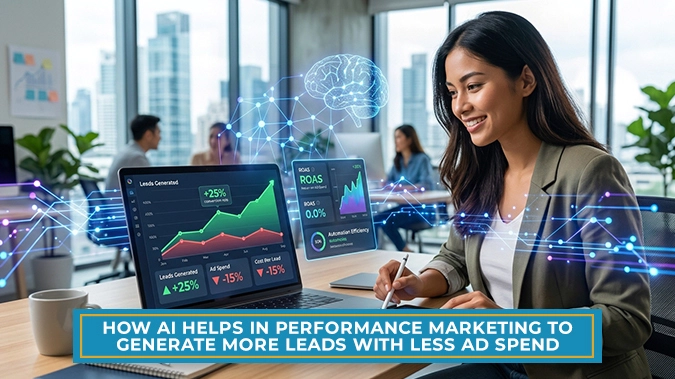
Overview: AI is reshaping performance marketing by helping businesses optimize campaigns, reduce advertising costs, and generate better-quality leads. It uses automation, predictive analytics, and machine learning to improve marketing efficiency and deliver stronger business results.
Key Takeaways
- AI identifies high-intent audiences.
- Smart bidding helps reduce ad spend.
- AI improves Google Ads and Meta Ads performance.
- Automated optimization boosts campaign efficiency.
- Personalized ads increase lead quality.
- Predictive insights support smarter marketing decisions.
- AI improves ROAS and lowers customer acquisition costs.
- Performance metrics help measure marketing success.
Are your advertising costs increasing while the quality of leads continues to decline? Are your marketing teams spending more time adjusting campaigns but still struggling to achieve predictable results?
The answer of the above questions rely within the changing landscape of digital advertising. Rising competition, increasing cost-per-click (CPC), changing customer behaviour, and stricter privacy regulations have made traditional campaign management less effective.
Businesses today need more than manual bidding, broad audience targeting, and basic reporting. They need smarter systems that can analyse large volumes of data, predict customer behaviour, and optimise campaigns in real time.
This is where AI in Performance Marketing is creating a major shift. Today, businesses can improve lead quality, reduce wasted ad spend, and achieve better returns from their marketing investments by using machine learning, predictive analytics, automation, and intelligent audience targeting.
In this blog of SALETIFY, we will understand why AI-powered performance marketing is beneficial for marketing teams to make faster, smarter, and more profitable decisions.
What Is AI-Powered Performance Marketing?
AI-powered performance marketing uses artificial intelligence, machine learning, and automation technologies to optimize digital advertising campaigns, improve targeting accuracy, and maximize marketing outcomes.
Traditional performance marketing relies heavily on manual analysis, historical data, and periodic campaign adjustments. AI-powered digital marketing services takes this further by continuously analysing real-time signals such as:
- Customer behaviour
- Search intent
- Engagement patterns
- Purchase probability
- Audience interactions
- Campaign performance data
AI helps businesses identify which audiences are more likely to convert, which campaigns deliver better results, and where advertising budgets should be allocated.
For example, an e-commerce brand running multiple campaigns can use AI to identify which customer segments have higher purchase intent and automatically prioritise budget towards those opportunities.
Why Traditional Performance Marketing Is Becoming Less Efficient
While paid advertising remains an important growth channel, many businesses are facing new challenges:
Rising Advertising Costs
Competition across Google Ads, Meta Ads, and other platforms has increased significantly. Businesses often need to spend more to reach the same audience compared to previous years.
Manual Optimisation Limitations
Traditional campaign management depends heavily on marketers analysing reports and making adjustments manually. This process can delay decision-making and miss valuable optimisation opportunities.
Changing Customer Journeys
Customers rarely follow a simple buying path. They interact with multiple channels, devices, and content formats before making a decision. Understanding these complex journeys requires advanced data analysis.
Privacy and Data Challenges
With reduced dependence on third-party cookies, businesses need smarter ways to use first-party data and understand customer intent.
Traditional Performance Marketing vs AI-Powered Performance Marketing
The transition from traditional marketing to AI-powered performance marketing is changing how businesses target audiences, manage budgets, and optimize campaigns. Here’s how both approaches compare:
|
Area |
Traditional Marketing |
AI-Powered Marketing |
|
Audience Targeting |
Based mainly on demographics |
Uses predictive customer behaviour analysis |
|
Campaign Optimisation |
Manual adjustments |
Real-time automated optimisation |
|
Budget Allocation |
Fixed distribution |
AI-driven budget prioritisation |
|
Ad Testing |
Limited variations |
Continuous creative testing |
|
Decision Making |
Historical reporting |
Predictive insights |
How AI Helps Generate More Leads While Spending Less
AI improves performance marketing by helping businesses make smarter decisions throughout the advertising journey.
Predictive Audience Targeting
One of the biggest advantages of AI is its ability to identify potential customers before they convert.
AI analyses customer behaviour, browsing patterns, engagement history, and conversion data to predict which audiences are more likely to take action.
This allows businesses to focus their budgets on high-value prospects instead of spending money on audiences with lower conversion potential.
AI-Powered Bidding Strategies
AI-driven bidding helps businesses optimize advertising spend by adjusting bids based on real-time conversion possibilities.
Platforms like Google Ads use machine learning through Smart Bidding to analyse signals such as:
- Device
- Location
- Search behaviour
- Time of interaction
- Conversion history
This helps businesses invest more in opportunities that are more likely to generate revenue.
Automated Budget Optimization
Managing budgets across multiple campaigns can become complicated. AI helps identify which campaigns, audiences, and platforms are delivering stronger results.
Instead of allocating equal budgets everywhere, AI automatically prioritises campaigns that show better conversion potential and reduces spending on low-performing areas.
This improves overall marketing efficiency and helps businesses achieve better ROAS.
Automated Campaign Management
AI-powered tools can automate repetitive campaign tasks such as:
- Performance monitoring
- Bid adjustments
- Audience analysis
- Search term evaluation
- Campaign recommendations
This allows marketing teams to spend more time on strategy and less time on manual campaign maintenance.
Dynamic Creative Optimization
The right message can significantly influence campaign performance. AI helps test multiple ad variations, including headlines, visuals, and descriptions, to identify which combinations perform better.
For example, AI can determine whether a particular customer segment responds better to a discount-focused message or a value-driven message.
AI-Driven Personalization
Modern customers expect relevant experiences. AI helps businesses personalise advertisements based on user behaviour, interests, and previous interactions.
Personalised campaigns improve engagement rates and increase the chances of converting prospects into customers.
Cross-Channel Optimization
Customers interact across multiple platforms before making decisions. AI helps businesses understand these interactions and optimise campaigns across channels such as:
- Google Ads
- Meta Ads
- LinkedIn Ads
- Display networks
- Email marketing platforms
This creates a connected marketing experience instead of isolated campaigns.
Saletify Marketing helps businesses implement AI-powered performance marketing strategies that combine automation, audience intelligence, and campaign optimization to improve lead generation and advertising efficiency.
AI Features That Improve Google Ads Performance
Google Ads has integrated several AI-powered features that help businesses optimize campaign performance.
Performance Max Campaigns
Performance Max uses machine learning to optimize campaigns across Google Search, Display, YouTube, Gmail, and Maps.
It analyses campaign goals and audience behaviour to find better conversion opportunities.
Smart Bidding
Smart Bidding automatically adjusts bids based on conversion probability, helping businesses maximise results within their advertising budget.
AI-Generated Assets
AI assists in creating headlines, descriptions, and creative combinations to test different messaging approaches.
Audience Signals and Predictive Insights
AI analyses customer data and audience behaviour to identify potential buyers who are more likely to engage.
How AI Optimizes Meta Ads for Better Lead Quality
Meta Ads also use AI-powered features to improve campaign performance.
Meta Advantage+
Meta Advantage+ campaigns use automation to optimise audience selection, placements, and delivery.
Automated Placements
AI identifies where ads are most likely to perform well across Facebook, Instagram, and other Meta platforms.
Lookalike Audiences
AI helps businesses discover new audiences similar to existing customers, improving targeting efficiency.
Creative Testing
AI evaluates different creative formats and identifies which advertisements generate better engagement and conversions.
Real Business Benefits of AI in Performance Marketing
Businesses adopting AI marketing strategies can achieve measurable improvements, including:
- Lower customer acquisition costs
- Improved lead quality
- Better conversion rates
- Reduced advertising waste
- Faster campaign optimisation
- Improved ROAS
- Scalable marketing growth
For companies investing in growth, AI performance marketing provides a smarter approach to achieving sustainable results.
AI Performance Marketing Across Different Industries
AI-powered advertising strategies can benefit multiple industries:
|
Industry |
AI Marketing Applications |
|
E-commerce |
Product recommendations, personalised ads, purchase prediction |
|
SaaS |
Lead scoring, customer acquisition, demo conversions |
|
Healthcare |
Patient targeting and appointment generation |
|
Education |
Course promotion and student acquisition |
|
Real Estate |
Buyer intent targeting and lead qualification |
|
B2B Services |
Account targeting and sales pipeline growth |
KPIs to Measure AI Marketing Success
Using AI does not eliminate the need for performance measurement. Businesses should track:
-
ROAS (Return on Ad Spend)
Measures revenue generated from advertising investment.
-
CAC (Customer Acquisition Cost)
Shows how efficiently a business acquires new customers.
-
CPA (Cost Per Acquisition)
Tracks the cost of generating conversions.
-
CTR (Click-Through Rate)
Measures advertisement engagement.
-
CVR (Conversion Rate)
Shows how effectively campaigns turn visitors into leads or customers.
-
Customer Lifetime Value (CLV)
Helps understand long-term customer profitability.
The Future of AI in Performance Marketing
AI will continue transforming digital advertising through:
- AI marketing agents managing campaigns autonomously
- Predictive customer journey mapping
- Privacy-focused advertising models
- Generative AI for creating campaign assets
- Advanced customer segmentation
Businesses that adopt AI early will have stronger opportunities to improve efficiency, understand customers better, and compete in an increasingly digital marketplace.
The Bottom Line
AI is changing performance marketing from a reactive advertising approach into a proactive growth strategy.
Businesses can generate better-quality leads while reducing unnecessary advertising costs by using predictive analytics, automation, intelligent targeting, and real-time optimisation.
The future of marketing will not be about spending more on ads. It will be about using technology to make every marketing decision smarter.
Saletify Marketing helps businesses in Performance Marketing Services with AI to optimise campaigns, improve lead quality, and maximise ROAS through intelligent data-driven strategies.
Ready to generate more leads while reducing your advertising costs? Saletify Marketing implements AI-powered performance strategies that deliver measurable business growth. Talk to our experts today and discover how AI can help your business generate more leads with less ad spend.
FAQs:
-
What is AI in performance marketing?
AI in performance marketing uses artificial intelligence and machine learning to optimize advertising campaigns, improve targeting, automate decisions, and increase marketing efficiency.
-
How does AI reduce advertising costs?
AI reduces costs by improving audience targeting, optimising bids, identifying high-performing campaigns, and reducing spending on low-value opportunities.
-
Can AI improve Google Ads performance?
Yes. AI features like Performance Max, Smart Bidding, and predictive insights help improve targeting, bidding decisions, and conversion performance.
-
How does AI optimize Meta Ads campaigns?
AI improves Meta Ads through automated placements, audience discovery, creative testing, and conversion optimisation using real-time performance data.
-
Is AI performance marketing suitable for small businesses?
Yes. Small businesses can use AI-powered tools to optimise budgets, reach relevant audiences, and compete more effectively without large marketing teams.
-
How does AI improve lead generation?
AI improves lead generation by identifying high-intent audiences, personalising campaigns, predicting customer behaviour, and improving conversion opportunities.