
ChatGPT Dots Launch: How OpenAI Is Changing the Future of AI Agents
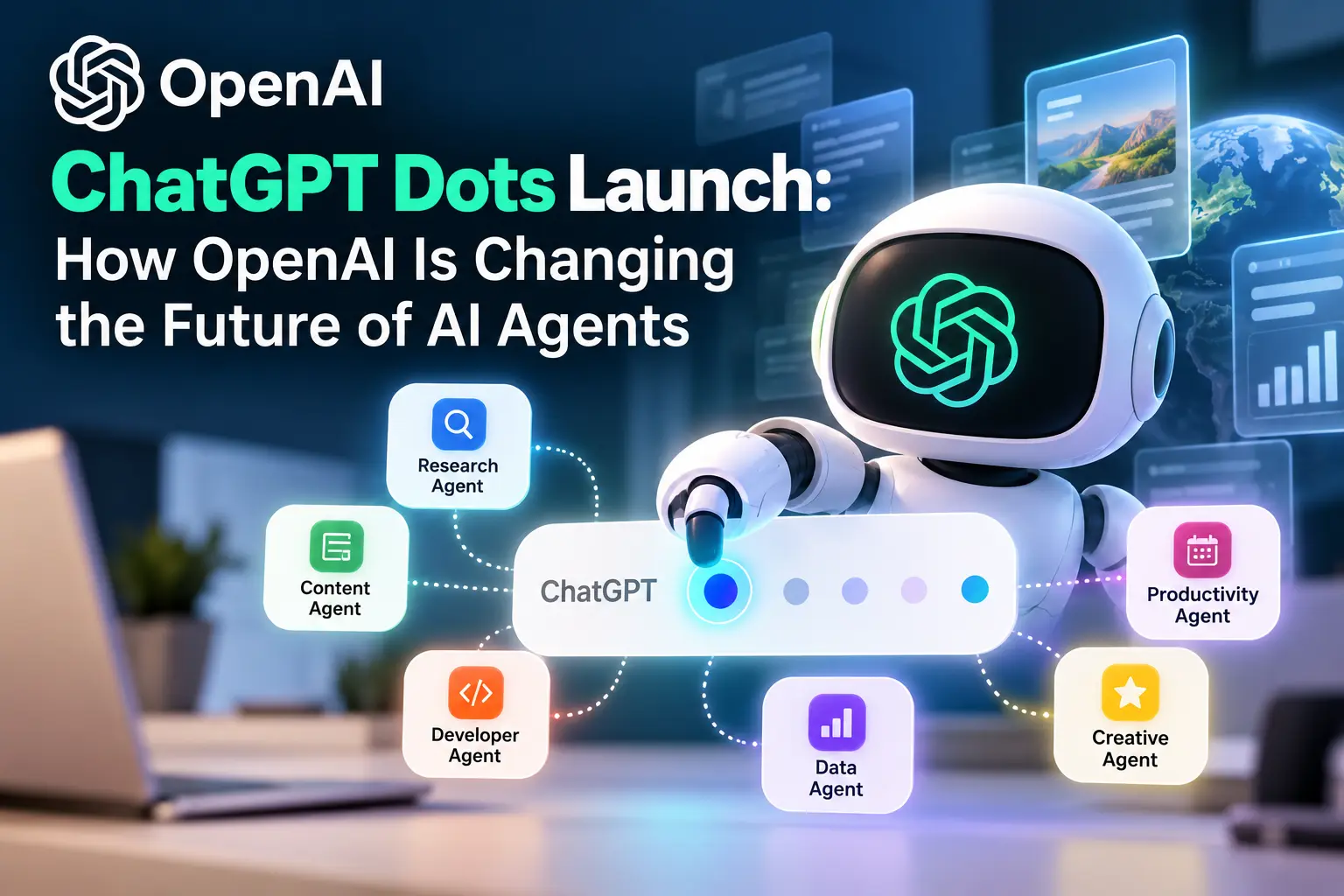
For years, using AI has meant opening a chat, typing a request, waiting for an answer, and deciding what to ask next. OpenAI’s ChatGPT Dots launch changes that pattern. Introduced on September 29, 2026, Dots are designed as proactive assistants inside ChatGPT. These advanced AI agents can keep working toward a goal, use connected tools, maintain context, and come back to you when a decision needs your input.
That shift matters for businesses. The question is moving from “What can AI answer?” to “What work can I continue handling after I walk away?”
One Minute Understanding of ChatGPT Dots
|
Traditional Chatbot |
AI Assistant |
ChatGPT Dot / AI Agent |
|
Responds to individual prompts |
Helps with defined tasks |
Takes ongoing responsibility for a goal |
|
Mostly conversation-based |
Uses selected tools |
Uses tools, apps, browser and cloud computer |
|
Usually waits for the next instruction |
May perform several steps |
Can continue working between conversations |
|
Limited task persistence |
Some context and memory |
Persistent context around ongoing work |
|
Human directs each stage |
Human guides important stages |
Human sets boundaries and reviews key decisions |
What Are ChatGPT Dots?
ChatGPT Dots are always-on AI agents designed to take responsibility for ongoing work rather than simply answer individual questions. Powered by GPT-6 Astra, a Dot has its own cloud computer and browser and can work with apps that choose to connect.
The important distinction is its persistence. You can give a Dot a responsibility, provide context and preferences, and let it continue making progress while you focus elsewhere.
Why Did OpenAI Launch ChatGPT Dots?
AI is moving beyond the chatbot model. Generative AI proved that machines can understand language and create useful outputs. The next step is giving AI systems the ability to plan, use tools, make progress and complete multi-step work.
Dots fit directly into that shift. OpenAI says they can work toward user goals around the clock, learn from feedback and connect with thousands of apps through its ecosystem.
For businesses, that could mean fewer workflows built around manually moving information from one tool to another.
How Do ChatGPT Dots Work?
The ChatGPT Dots are built with the blend of five layers, way different than simple AI models. These layers include a capable model, persistent context, a cloud computer, connected apps, and a control system.
1. GPT-6 Astra Understands the Goal
At the centre is GPT-6 Astra, which helps the Dot understand what you want to achieve, work through unclear instructions, and ask questions when it needs more direction. But the model is only the starting point. To handle ongoing work, the Dot also needs access to tools, information, computing resources, and clear rules.
2. A Dedicated Cloud Computer Handles the Work
Each Dot has its own cloud computer where it can browse the web, work with files, use tools, and carry out tasks. This gives the agent a workspace where it can actually perform work instead of simply telling you how to do it. If you choose to connect your own computer, additional permissions determine what the Dot can access.
3. Connected Apps Give It the Right Context
Dots can work with apps and services you choose to connect. This allows an agent to access relevant information and use the tools required for a task. The important part is that you control those connections. A Dot only gets the access and permissions you provide.
4. Your Feedback Helps It Work More Consistently
A Dot can build an understanding of your preferences, goals, working style, and expectations over time. That context can help it produce more consistent work instead of starting from scratch with every task.
For example, a content team could give a Dot its brand voice, audience guidelines, research standards, and review checklist. It could then use those preferences when turning a new interview or research document into drafts and social content for review.
5. Controls Keep the Agent Within Boundaries
The final layer is control. Permissions, Custom Rules, approvals, and action checks help determine what a Dot can do on its own and when it needs human input.
That distinction matters. An incorrect answer in a chat is one problem. An agent sending the wrong email, editing the wrong file, or changing information in a business system can have much bigger consequences. For that reason, AI agents need clear boundaries and human oversight, not unlimited access.
Key ChatGPT Dots Features Today’s Businesses Should Know
The most relevant capabilities for businesses include:
- Always-on operation: Dots can continue working beyond a single conversation.
- Ongoing tasks: They can manage projects rather than isolated prompts.
- Connected apps: Users can choose which services a Dot can access.
- Cloud computer and browser: Each Dot has its own computing environment for carrying out work.
- Persistent context: Dots can use relevant memory, conversations and connected information.
- Progress updates: They can contact users with progress, questions or decisions.
- Controls and permissions: Custom Rules can determine which actions are allowed, blocked or require approval.
Availability is still rolling out. OpenAI currently lists access for Pro and Business Premium users in eligible markets, with Enterprise access through workspace administration and expansion planned.
ChatGPT Dots vs AI Assistants vs AI Agents
The table below will help you understand the key differences between these three AI agents:
|
Traits |
Traditional ChatGPT |
AI Assistant |
ChatGPT Dot/AI Agent |
|
Main Role |
Answers or creates |
Helps with tasks |
Takes responsibility for an ongoing goal |
|
Interaction |
Prompt-driven |
User-guided |
Goal-driven |
|
Context |
Conversation-based |
Task-based |
Persistent, ongoing context |
|
Work Style |
One request at a time |
Multi-step assistance |
Continues work over time |
|
Tools |
Available tools |
Selected tools |
Connected apps + cloud computer |
|
Autonomy |
Limited |
Moderate |
Higher, within defined permissions |
|
Human Improvement |
Frequent |
Regular |
Review and intervention when needed |
|
Best suited for |
Questions and creation |
Assisted productivity |
Ongoing workflows and automation |
The important distinction is persistence.
A chatbot waits for you.
An agent can keep working towards a defined objective.
OpenAI's current documentation describes Dots as having their own cloud computers, connected-app access, scheduled tasks and background research capabilities.
How ChatGPT Dots Could Change Business Automation
The use of ChatGPT dots cannot replace entire jobs. It can remove the repetitive coordination work surrounding them.
Marketing Research
A Dot could help monitor competitors, collect market information, organize findings and prepare recurring research updates.
Lead Research and Qualification
With appropriate data access and controls, agents could assist with researching prospects, enriching information and preparing lead summaries for sales teams.
Reporting and Data Analysis
Instead of manually compiling recurring reports, teams could delegate data collection, trend identification and first-draft analysis.
Content and Campaign Workflows
Agents could support research, content planning, performance reviews and campaign monitoring while humans retain editorial and strategic control.
Administrative Tasks
Scheduling checks, organizing information, preparing summaries and recurring follow-ups are natural candidates for agentic automation.
Customer and Competitor Research
A persistent agent could continuously monitor permitted sources and flag relevant changes rather than requiring a new research request every time.
How ChatGPT Dots Could Change Digital Marketing
This is where the launch becomes interesting for agencies and marketing teams.
Imagine a marketing agent that does not simply generate a blog when prompted.
Instead, it could potentially support an ongoing workflow involving:
Research → content opportunities → competitor monitoring → campaign analysis → reporting → optimization
AI Agents for SEO teams, that could mean recurring keyword and competitor research.
For content teams, it could mean monitoring questions, trends and content gaps.
For performance marketers, it could mean assisting with recurring campaign analysis.
For social teams, it could support content research and performance monitoring.
And for brands investing in AEO and GEO, persistent agents could help analyze how their content and competitors appear across changing AI-search experiences.
SALETIFY can build on this broader shift through AI-Powered Digital Marketing Services, where AI is treated as part of the marketing workflow rather than simply another content-generation tool.
What Could ChatGPT Dots Mean for the Future of AI Agents?
The most important change may be psychological.
We have spent years learning how to prompt AI.
The next stage may require businesses to learn how to delegate to AI.
Instead of asking:
“What are our competitors doing?”
The instruction becomes:
“Monitor our key competitors, identify meaningful changes and prepare a weekly summary for review.”
Instead of:
“Analyse this campaign.”
It becomes:
“Monitor campaign performance and flag unusual changes with supporting data.”
That is a fundamentally different relationship with software.
Are ChatGPT Dots Available in India?
OpenAI says Dots are rolling out gradually to eligible Pro users in supported markets, with the European Economic Area, Switzerland, and the UK excluded from Pro access at launch. Business Premium availability is broader across ChatGPT regions, while Enterprise access is currently a beta controlled by workspace administrators.
As the rollout is gradual, availability should be checked against the user’s current ChatGPT account and plan rather than assumed from the launch announcement.
Final Words
ChatGPT Dots are not simply another chatbot feature. They represent a broader direction for AI. These persistent systems can remember context, access tools, pursue goals and continue working after the initial instruction.
For businesses, the opportunity is significant, but so is the responsibility. The companies that benefit from AI agents will not necessarily be those that automate the most. They will be the ones that identify the right workflows, provide the right context, establish sensible permissions and keep human judgement where it matters.
FAQs:
- What are ChatGPT Dots?
ChatGPT Dots are AI agents designed to handle ongoing tasks, use connected tools, maintain context, and continue working toward a goal with less day-to-day input. - How do ChatGPT Dots work?
Dots combine an AI model with persistent context, a cloud computer, connected apps, and user-defined controls. This allows them to carry out multi-step tasks and ask for input when needed. - How are ChatGPT Dots different from regular ChatGPT?
Regular ChatGPT mainly responds to prompts, while Dots are designed to work toward ongoing goals. They can continue tasks, use connected tools, and operate within defined permissions. - Can businesses use ChatGPT Dots for automation?
Yes. Businesses can use Dots to support tasks such as research, reporting, lead research, content workflows, competitor monitoring, and recurring administrative work, while keeping human oversight for important decisions. - Are ChatGPT Dots available in India?
Availability is being rolled out gradually and depends on the ChatGPT plan and region. Users in India should check their current ChatGPT account to see whether Dots are available to them.