

How the 70-20-10 Framework Improves Marketing ROI and Campaign Efficiency
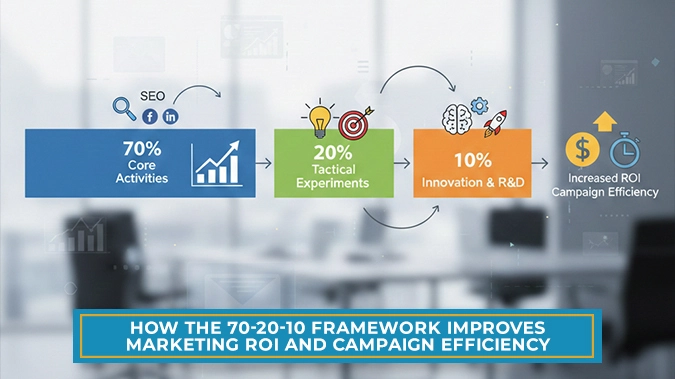
The 70-20-10 marketing framework boosts ROI and campaign efficiency by providing a structured, balanced approach to resource allocation, allowing businesses to maintain stable, high-performing strategies while simultaneously investing in growth and innovation.
Definition of the the 70-20-10 framework:
- 70% - Core Activities (Proven & Reliable)
- 20% - Growth Activities (Optimized & Improved)
- 10% - Experimental Activities (Innovative & Risky)
This structure ensures that most of your resources are allocated to proven strategies, along with allowing space for improvement and innovation.
Here is how the 70-20-10 framework boosts marketing ROI and efficiency:
- Maximizing ROI through structured allocation
- Enhancing campaign efficiency
- Benefitting marketing performance
In today’s rapidly evolving digital landscape, most marketers face a constant challenge, that is, how to balance proven strategies along with adapting innovations for a consistent leap in growth. Businesses who focus solely on what already works can slow down the growth tangent, however, chasing every new trend can waste budget and effort. This is where the rise of the 70-20-10 rule in digital marketing can act as a key solution to this emerging challenge.
The 70-20-10 rule helps modern businesses allocate the resources into three distinct segments, including time, budget, and resources. This model ensures the resources are effectively allotted across safe, growth-oriented, and experimental marketing activities, creating a balanced environment that supports steady performance and promotes innovation simultaneously.
In this blog post, we will discuss how this framework is helping businesses build long-term growth while experimenting new opportunities at the same time.
What Is the 70-20-10 Framework in Marketing?
The 70-20-10 framework in marketing is a strategic resource allocation model that helps brands balance stability, growth, and innovation. It is designed to ensure consistent performance while allowing for future-proofing and creativity.
The 70-20-10 model originated in the 1980s from research by Morgan McCall, Michael Lombardo, and Robert Eichinger at the Center for Creative Leadership (CCL). It was originally developed as a Learning & Development (L&D) framework, proposing that 70% of learning happens through experience, 20% through social interaction, and 10% through formal training.
The model was later adapted for corporate strategy and, notably, by companies like Google to manage innovation. Moreover, Coca-Cola also famously adopted this, adapting it for content investment, often called the “now/next/new" model internally.
Why Marketers Use It Today?
Marketers use this framework to stay agile and prevent over-investing in either stagnation or new tools. The key benefits of using this model are as following:
- Balanced Risk and Reward: It protects the core business (70%) while allowing for innovation (10%) that could yield high profits.
- Consistency and Sustainability: The 70% of proven content ensures a steady flow of leads and keeps the brand visible, reducing dependence on fickle, trending, or organic, algorithmic reach.
- Structured Innovation: Rather than gambling with the entire budget, it forces marketers to limit risky, new ideas to 10% of their effort.
- Data-Driven Evolution: As experiments (10%) prove successful, they can move into the 20% (growth) or 70% (core) buckets, allowing the strategy to evolve based on performance.
- Lower Burnout: It provides a clear structure that helps marketing teams prioritize and avoid the pressure of constantly having to create viral content.
Why Marketing ROI and Campaign Efficiency Matter?
In today’s competitive landscape, measuring marketing ROI and maximizing campaign efficiency are no longer optional, they are the main determinants of the survival and growth of the business. ROI and campaign efficiency mainly matters to address two main points which include:
- Combating rising acquisition costs:
As digital ad platforms grow crowded and privacy rules tighten, acquiring new customers has become more expensive than ever. If Customer Acquisition Costs (CAC) of a company exceeds its Customer Lifetime Value (LTV), you’re losing money with every sale. Tracking ROI helps spot underperforming channels, improve efficiency, and rebalance spend, often revealing that retaining customers is far more cost-effective than constant new acquisition.
- Driving predictable growth:
Predictable growth of a business mainly relies on understanding customer behavior and consistently generating revenue, rather than relying on inconsistent highs and lows. Businesses can set clear benchmarks and forecast future revenue with far greater accuracy by tracking the ROI of past campaigns.
Understanding which marketing efforts deliver the strongest results helps allocate budgets wisely, minimize wasted spend, and maintain a steady flow of leads. With the right analytics in place, companies can anticipate churn and shifts in customer behavior early, enabling a more proactive and stable approach to growth.
Breaking Down the 70-20-10 Framework
The framework divides marketing activity into three distinct buckets including:
70% — Core Activities (Proven and Reliable): This division represents the majority of effort invested in established, high-ROI channels that drive current business. For example, it mainly emphasizes:
- Ongoing SEO,
- Established email marketing,
- PPC campaigns that consistently deliver results.
20% — Growth Activities (Optimized and Improved): This is dedicated to scaling or refining promising campaigns. For example, this includes trying new ad formats like:
- Video instead of image,
- A/B testing landing pages
- Exploring new or related platforms
10% — Innovation & Experimentation (Innovative and Risky): This part of the model focuses on high-risk, high-reward, "wild" ideas that have no previous performance data. For example, it includes:
- Testing new AI-driven tools,
- Emerging social platforms,
- Experimental ad campaigns
How the 70-20-10 Framework Improves Marketing ROI
The 70-20-20 framework helps improve ROI of a business by structuring budget and effort into three distinct and goal-oriented buckets. Here is how the framework drives ROI through the specified areas:
- Risk Mitigation:
The 70-20-10 model helps protect marketing budgets by balancing safety and experimentation. The baseline revenue stays stable by allocating 70% to proven channels like SEO, PPC, and email, while only 10% is spent on high-risk experiments, limiting potential losses. The 20% middle bucket tests new strategies on a manageable scale, using data to decide what’s worth scaling.
- Performance Scaling:
The framework creates a clear path for new ideas to grow into core strategies. Successful 10% experiments move to the 20% testing phase, and then into the 70% core for consistent scaling. The 20% also supports near-core growth, while regular reviews and rebalancing ensure resources shift to high-performing channels, thereby boosting overall ROI by 10–20%.
- Budget Efficiency:
The framework minimizes wasted ad spend by aligning resources with proven performance and specific goals. It boosts budget efficiency by focusing resources where they matter most. It avoids spreading spend too thin by dedicating 70% to high-ROI channels, the 20% is used to optimize campaigns through A/B testing and CRO, thereby improving returns without extra spend. The 10% fosters targeted innovation with clear KPIs, treating experiments as structured R&D.
Use of the 70-20-10 Model to Increase Campaign Efficiency
The 70-20-10 model is primarily used to increase campaign efficiency by creating a structured balance between proven performance methods, optimization, and innovation. The prime strategy includes:
- Resource prioritization: The 70-20-10 model allocates 70% to proven channels for stable results, 20% to testing and optimizing new strategies, and 10% to high-risk, innovative experiments like AI, VR, or disruptive content targeting untapped audiences.
- Faster learning cycles: The model drastically reduces the time between identifying a new opportunity and validating its business value.
- Cross-channel alignment: The framework ensures that all channels work together, strengthening brand authority and reducing the waste associated with fragmented or conflicting messaging.
Real-World Examples of the 70-20-10 Marketing Framework
B2B example: This framework has highly benefited leading B2B companies like Microsoft by allocating a larger experimental percentage nearly about 15-20% owing to the significant evolution of their market.
At the same time, Hubspot and many other SaaS-based companies have nurtured long-sales cycles by focusing heavily on 70% of SEO-optimized blog posts and 20% of running webinar series and account-based marketing campaigns.
B2C example: Similarly, companies like Procter & Gamble mostly maintain stricter adherence to the 70% core spending due to the stability of their customer relationships and sales channels.
On the other hand, Coca-Cola maintained its market leadership and expanded its connections with new generations of consumers by implementing the global version of this framework.
Common Mistakes When Applying the 70-20-10 Framework
- Misallocating Budgets: Spending too much on risky ideas can quickly drain budgets. So, try to keep experimentation within the 10% allocation.
- Ignoring Experimentation Insights: Every activity needs measurement. Analytics are essential to know which experiments to scale into the 20% or 70% buckets.
- Not Scaling Successful Experiments: When a 10% experiment succeeds, move it up to the 20% or 70% category to maximize impact.
How to Implement the 70-20-10 Framework Step by Step
The below are the steps that would help you to incorporate the 70-20-10 framework effectively:
Audit existing campaigns: Before allocating budgets, you need to understand the current performance of all marketing activities, by:
- Categorizing activities
- Analyzing ROI
- Identifying growth potential
- Finding out innovation gaps
- Creating a record of past wins and failures
Assign budgets: Distribute your budget, time, and team resources according to the 70-20-10 ratios to balance stability with innovation. For this, you need to:
- Allocate 70% of the budget to established channels, for example Google Ads, existing SEO, and email marketing
- Assign 20% of resources to expanding successful pilot programs, to improve Conversion Rate Optimization (CRO)
- Reserve 10% for high-risk initiatives, such as adopting new AI tools, testing emerging platforms, for say, Threads, and new social apps.
Measure and iterate: Regularly review performance to move initiatives between categories based on success. This can be achieved by:
- Setting specific metrics
- Making quarterly reviews
- Testing whether the 10% experimental model scales or fails fast
- Continuously adapting to the budget and strategy based on market changes
The Bottom Line
The 70-20-10 framework offers a strategic balance between stability, growth, and innovation, helping businesses optimize marketing ROI while minimizing risk. Brands can drive consistent performance, uncover new opportunities, and stay agile in a rapidly evolving digital landscape by dedicating resources to proven channels, scaling promising initiatives, and experimenting in a controlled way.
Apply the 70-20-10 framework to your next campaign and audit your marketing budget for higher ROI with SALETIFY, one of the best Digital Marketing Agencies in Pune!
FAQs:
- What is the 70-20-10 framework in marketing?
The 70-20-10 framework is a budget allocation strategy where 70% is invested in proven campaigns, 20% in optimizing and testing new variations, and 10% in innovative experiments.
- How does the 70-20-10 framework improve marketing ROI?
It maximizes ROI by focusing most of the budget on high-performing activities while still allowing room for testing and breakthrough ideas.
- Why is the 70-20-10 framework effective for campaign efficiency?
It balances stability and innovation, ensuring consistent performance while encouraging data-driven experimentation for long-term growth.
- What types of campaigns should be included in the 70% category?
The 70% should include well-optimized, high-converting campaigns such as core SEO efforts, evergreen PPC ads, and proven email marketing funnels.
- What kinds of experiments belong in the 10% innovation bucket?
The 10% should focus on bold initiatives like new platforms, emerging ad formats, AI-driven personalization, or creative campaign concepts.
- Is the 70-20-10 framework suitable for small businesses?
Yes, it helps small businesses manage limited budgets wisely by prioritizing reliable strategies while still exploring growth opportunities.