What Is AIO? A Guide for Modern Businesses to Redefine Their Digital Presence
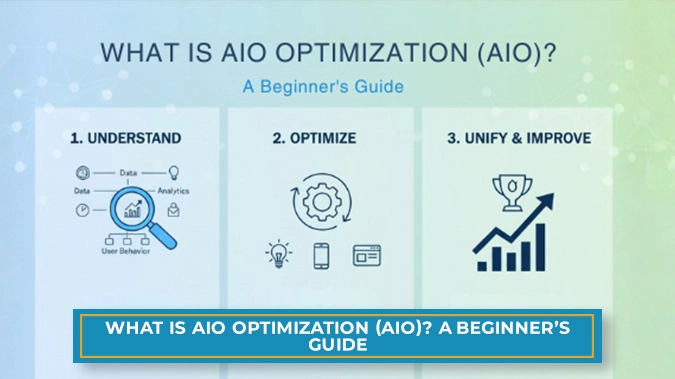
In this tech-driven era, Artificial Intelligence has no longer remained a futuristic concept, it has reshaped various industries in recent years. However, simply utilizing AI is not just enough. Nowadays, many leading businesses and professionals have started focusing on a new concept, called AIO, to manage their digital reputation in the AI-driven world.
What Does Artificial Intelligence Optimization (AIO) Mean?
AIO has emerged as a key revolution in content strategy. It is a process of optimizing, crafting, and distributing content that is designed to perform even better across AI-powered ecosystems. This method is way different than traditional search engine results.
In simpler words, AIO means how AI-powered systems, such as large language models (LLMs), recommendation engines, chatbots, and voice assistants analyze, synthesize, and respond to users’ information. The goal behind using AIO to rank the content better, but to make it capable of generating real-time answers, summarizes data, and boosts user interactions.
The Evolution from SEO to AIO
The rise of AI has fundamentally changed how AI has interacted with information fundamentally. Search engines like Google and Bing, the primary holder of digital data, are now sharing the stage with AI tools such as ChatGPT and Gemini. These advanced tools have offered more conversational and content-aware responses, eliminating the need for traditional search results. This has led to the rise of AIO that has overpowered SEO which has been driving the digital world for the last few decades.
Previously, SEO companies used to primarily relied on search engines to improve their visibility. It helped brands and companies to rank better on search engines, by optimizing their websites with relevant content, keywords, and backlinks. However, as AI tools offer synthesized and direct responses to user queries, changing the entire concept of content ranking.
AI systems offer users with one-two tailored answers instead of a list of search results. This enables individuals and businesses to upgrade their digital appearance by upgrading their content to come under AI-generated responses.
How AIO Works in AI-Powered Search Engines
AIO works in AI-powered search engines by gaining information from multiple web-sources to form a concise, conversational summary directly within search results. Here are the following ways in which Ai is transforming the rules of how content is created and discovered:
- AI-generated content: AI models, such as LLMs perform best when the information is clear and easy to interpret. AIO-optimized content, therefore, focuses on using simple, precise language, minimizing jargon, and providing direct answers to frequently asked questions.
- Structured and contextual Content: Generative-AI systems grasp context and relationships between concepts. Implementing structured data, such as schema markup, enables businesses to interpret and classify their content accurately. Further, semantic optimization further ensures your content aligns with the AI’s conceptual understanding for better visibility and relevance.
- Accuracy and verification: AI systems mostly rely on principles like Google’s E-E-A-T (Experience, Expertise, Authoritativeness, and Trustworthiness) to assess the reliability and safety of content, particularly when dealing with sensitive or high-stakes topics.
- Personalized Content: AIO focuses on delivering highly personalized results by factoring in a user’s search history, preferences, contextual behavior, and location. This means SEO professionals adapt to a more individualized search environment, optimizing for keywords and unique context behind each query, aligning with the preferences and search patterns of users.
Key Elements of AIO Strategy
Following are the key elements that help implement AIO strategy:
• Optimizing for AI Overview
AI-powered search engines like Google’s SGE or ChatGPT summarize information in AI Overviews. To appear here, content must provide clear, factual, and complete answers to user queries.
• Structuring content for LLM understanding
Large Language Models (LLMs) process content semantically rather than by keyword matching. A content with natural language, logical headings, bullet points, and coherent flow, helps AI models interpret meaning accurately and use your content in summaries or answers.
• Entity-based content optimization
Entity-based optimization focuses on building relationships between people, places, brands, and topics mentioned in your content. By clearly defining and linking entities using schema markup or context cues, you help AI understand how concepts connect. This improves visibility, authority, and relevance in AI-generated search and recommendation systems.
Key Differences Between AIO and SEO
|
Aspect |
Traditional SEO |
Artificial Intelligence Optimization (AIO) |
|
Prime Goal |
To rank content in search engine result pages (SERPs) for specific keywords to drive clicks. |
To upgrade content to be recognized by AI as a reliable source. This means making content to reflect in AI overview not in a traditional blue link. |
|
Content Strategy |
Emphasizes keyword density and on-page optimization. |
Emphasizes generating content that answers user questions and in a conversational and comprehensive way. |
|
User Intent |
It understands only keywords to match content with user search queries. |
It mainly understands user intent more thoroughly through natural languages, conversational queries, or voice searches |
|
Optimization Focus |
Optimizing content with a static set of rules and algorithms. |
Optimizing content for AI systems that understand context, user behavior, and E-E-A-T credibility |
|
Data Structure |
Uses meta tags and structured data for search engines. |
It uses detailed structured data like schema tags to make information more easily digestible by AI. |
Tools and Techniques for AIO Success
The successful integration of AI for IT operations relies on a blend of core tools and strategic techniques for various reasons. They help modern businesses to automate processes, gain real-time insights, and prevent problems proactively rather than from reactive troubleshooting. Here are the following tools that help businesses to implement AIO successfully:
1. For AI Content Optimization
a. SurferSEO,
b. Clearscope,
c. Frase,
d. MarketMuse
2. For Structured Data and Schema Markup
a. Google’s Structured Data Markup Helper
b. Schema.org
3. For Entity and Topic Mapping
a. SEMrush’s Topic Research
b. Ahrefs,
c. InLinks
4. NLP (Natural Language Processing) Analyzers
a. IBM Watson NLU,
b. Google Cloud NLP,
c. OpenAI Embeddings
5. Data Analytics and Personalization Tools
a. GoogleAnalytics 4
b. Hotjar,
c. HubSpot
How Businesses Can Implement AIO Today
Many digital marketing agencies, these days, are rapidly adapting more intelligent and adaptive approaches to successfully implement AI optimization today. They have started utilizing AI tools for content creation and management, gathering high-quality data, setting clear goals, and training team members with updated knowledge. Here are few steps that help companies automate tasks, analyze real-time insights, run hyper-personalize campaigns and improve customer experiences:
- Setting clear goals and building an ethical framework
- Integrating AI tools to generate content, automate ad management, and explore AI-driven customer service
- Embracing predictive analytics and creating personalized content
- Optimizing email campaigns, training teams, and implementing feedback loop
Future of Artificial Intelligence Optimization
The future of AI Optimization (AIO) seems very expanding as many businesses have started integrating AI models with existing business systems to enhance efficiency, performance, and decision-making. Many tech-giants have started using AI not just to use it but to optimize other AI systems, ensuring smarter automation and continuous improvement. Moreover, several organizations are increasingly focused on AI-driven search optimization, advanced simulations, and predictive engineering for faster innovation and precision.
Futuristic trends in AI optimization
- Developing AI systems to optimize other AI models
- Using AI for personalized experiences
- Reducing operational costs and promoting cloud usage and supply chain management
- Combining predictive analysis to improve decision making
- Improving chatbots and virtual assistants for businesses to handle natural human language
Endnote
Artificial Intelligence Optimization (AIO) represents the next phase of digital evolution, overcoming the limitations of traditional SEO to align with AI-driven search behavior. Businesses can enhance visibility in AI-generated results by using structured data, entity-based optimization, and personalization. AIO focuses on creating trustworthy, contextual content that connects humans and intelligent systems, boosting content authenticity, user engagement, and sustainable digital growth.
FAQs:
1. What is Artificial Intelligence Optimization (AIO)?
AIO is the process of optimizing content to perform effectively across AI-powered systems like chatbots, voice assistants, and AI search engines.
2. How is AIO different from traditional SEO?
Unlike SEO, which focuses on keyword rankings, AIO optimizes content for AI understanding, context, and user intent.
3. Why is AIO important for businesses today?
AIO helps businesses stay visible in AI-generated search results and enhances digital credibility in an AI-driven world.
4. What tools can help in implementing AIO?
Tools like SurferSEO, Clearscope, Schema.org, and Google Analytics 4 assist in content optimization, structure, and personalization.
5. What does the future of AIO look like?
The future of AIO lies in AI systems optimizing other AI models, enabling smarter automation, personalization, and business growth.