

Digital Marketing KPIs to Skyrocket Your Business Growth in 2026
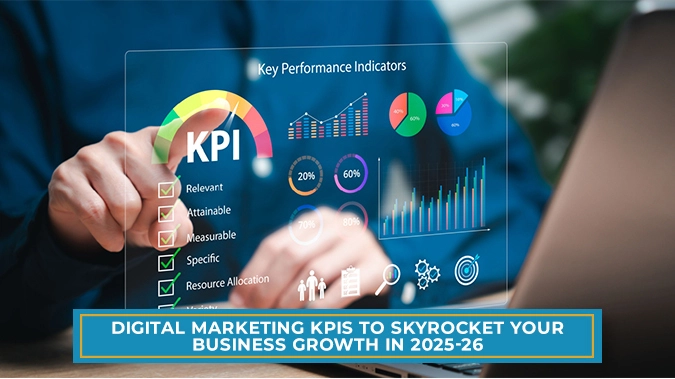
Digital marketing KPIs are vital for measuring campaign success and driving growth. Key metrics include website traffic, conversion rates, CTR, ROI, CAC vs. CLV, social media engagement, email performance, and SEO indicators. These data-driven benchmarks help businesses optimize strategies, allocate budgets effectively, and align marketing with ROI-focused goals, ensuring sustainable growth in the competitive digital landscape.
In this rapidly-evolving, hyper-competitive digital era, relying only on instinct is not sufficient. Key performance indicators in digital marketing have emerged as measurable values in the last few years that help guide modern businesses to boost their online presence.
KPIs act as indicators, providing data-driven insights for companies to evaluate the successful running of campaigns. These quantifiable metrics also help them track progress toward goals, and ensure marketing efforts into concrete and actionable to drive their strategic decision-making.
What Are KPIs in Digital Marketing?
KPIs stand for Key Performance Indicator, which is used as a measurable value to demonstrate businesses how effectively they could achieve their objectives. In digital marketing, KPIs are widely used to track and measure the performance of various marketing components and initiatives. KPIs can vary depending on the goals and objectives of an organization, but should always be relevant to the core value.
In this current age, the use of KPIs is essential in digital marketing, as they allow marketers to examine the success of their campaigns and make data-driven decisions to find their loopholes and optimize their efforts. Without using KPIs, digital marketing agencies could be left guessing about the effectiveness of their campaigns which could result in missed opportunities and wasted resources.
How Does KPI Work in Digital Marketing?
In digital marketing, KPIs serve as key factors of performance measurement, helping brands turn raw data into actionable insights. They reveal how effectively marketing strategies are achieving desired outcomes and guide marketers in refining campaigns to get better results.
- KPIs act as measurable benchmarks that evaluate the success of marketing campaigns.
- They track specific goals such as website traffic, conversions, or engagement.
- Marketers use KPI data to identify which strategies perform best and which need improvement.
- KPIs connect marketing activities directly to business objectives like ROI and customer retention.
- Continuous monitoring of KPIs helps optimize campaigns in real time.
- Data from KPIs supports smarter, evidence-based decision-making rather than guesswork.
- They help allocate budgets efficiently toward high-performing channels and audiences.
Many brands also collaborate with an experienced Digital Marketing Agency in Pune to monitor these KPIs effectively and optimize their campaigns for consistent growth.
Top Digital Marketing KPIs to Track in 2026
In 2026, businesses are widely looking to run smart campaigns and need to look at the right numbers. Here are some best marketing KPIs that help organizations to know where their efforts are going on and what they will get in return:
1] Website Traffic & Engagement Metrics
The KPIs for website traffic show how many people are visiting the website, including both the new ones and the existing ones. Organizations are also able to see the sources of traffic, such as Google, ads, or social media. More traffic implies your business is getting more reach. If traffic numbers fall now, then it indicates there is something not right. However, if it goes up, then its ads and content are doing great.
In simpler words, this digital marketing KPI helps businesses understand whether their online presence is attracting the right audiences or not and how users interact with their content. It mainly measures:
- Total website traffic
- Traffic sources
- Time on Page and Bounce Rate
- Pages for session
2] Conversion Rate & Lead Quality
This particular KPI represents, out of maximum audiences who visit the website, how many actually are taking actions. These actions include how many are actually purchasing something, filling a form, or contacting you. This KPI exactly tells whether the company’s effort is getting real results or just clicks.
It measures:
- Percentage of visitors completing a desired action
- Focus on quality of leads generated
- The efficiency of lead generation and customer acquisition
3] CTR (Click-Through Rate) in Digital Marketing
This KPI helps assess the effectiveness of specific call to actions (CTAs), ads, and subject lines. It measures:
- The ratio of users who click on specific links or who view the ads running on the websites.
- A high CTR showcases that the ad copy and creative are compelling and relevant or not.
4] ROI in Digital Marketing Campaigns
There are two types of ROIs while digital marketing campaigns. Return on marketing investment (ROMI) and return on Ad Spend (ROAS).
- ROMI calculates the financial return that is generated by marketing efforts
- On the other hand, ROAS calculates the revenue generated for every dollar spent on ads.
5] Customer Acquisition Cost (CAC) & Lifetime Value (CLV)
These are the most important KPIs in digital marketing that possess following aspects:
- CAC represents the total expenses made to gain a new paying customer.
- However, customer lifetime value (CLV) describes the total revenue a customer expected to generate over their relationship with the respective company. CLV:CAC ratio should be higher and equal to 3:1. This ratio indicates long-term profitability and sustainable growth.
6] Social Media & Content Engagement Metrics
These KPIs are the must-track metrics that are highly essential for brand awareness, engagement, and community growth. You can understand the social media content KPI with the help of following table:
On the other hand, content engagement metrics mainly focus on meaningful interactions of customers. This include following aspects including:
- Engagement depth: This includes the number of direct message shares by customers, their comment sentiments, and the number of saves they made.
- Audience retention: This showcases the number of return visits and repeat interactions users made which reflects the long-term loyalty of the content.
7. Email Marketing KPIs
In this current age, email marketing still remains the best options for many businesses. It acts as key strategies for businesses to keep people connected to them. In emails, brands can share much information, including offers, updates, or other important information. This KPI especially measures:
- Open rate
- Click-through Rate (CTR)
- Email conversion rate
8. SEO & Organic Performance Indicators
Over the years, SEO Companies are evolving with AI-powered search experiences to track organic performances. It measures:
- Organic traffic and traffic sources
- AI and voice search ranking
- Generative engine optimization and answer engine optimization
- How often the content is featured in voice assistant queries and AI-generated answers by natural language phrasing and structured data.
- Key ranking factors that boost the authority and relevance of the website
- Loading time of page
How to Measure and Analyze Digital Marketing Performance Metrics
There are various tools that help businesses and enterprises track the performance of the website by tracking multiple frameworks. Here are the major apps that help could help businesses improve their digital presence:
Linking KPIs to ROI – Turning Data into Strategy
Key Performance Indicators (KPIs) are more than just numbers, they actually represent actionable insights that, when interpreted correctly, can directly influence business growth and profitability. Organizations must align them with measurable business goals and use data to drive informed decisions to transform KPIs into strategic action.
- Align KPIs with Objectives: Businesses should ensure each KPI connects to specific revenue, customer, or operational goals
- Identify Performance Gaps: Use data trends to highlight underperforming areas needing immediate attention.
- Prioritize High-Impact Metrics: Focus on KPIs that have the strongest correlation with ROI.
- Implement Data-Driven Actions: Turn insights into initiatives such as marketing optimization or process improvement.
- Review and Adjust: Continuously monitor results to refine strategies and sustain growth.
Common Mistakes Marketers Make When Tracking KPIs
Many marketers fall into the trap of tracking numbers that look impressive but offer little real business value. Misinterpreting data or focusing on vanity metrics can lead to misguided strategies and wasted resources. Marketers should focus on relevance and accuracy over volume to ensure meaningful insights.
- Chasing Vanity Metrics: Tracking likes, followers, or impressions without linking them to conversions or ROI.
- Ignoring Context: Evaluating data in isolation without considering external factors or campaign goals.
- Overlooking Data Quality: Making decisions based on incomplete or inaccurate data.
- Misreading Trends: Reacting to short-term fluctuations instead of analyzing long-term patterns.
- Lack of Alignment: Using KPIs that don’t align with broader business objectives.
Future Trends: The Evolving Role of KPIs in AI-Driven Marketing
In 2026, it is expected that automation, AI, and predictive analytics is going to redefine KPI tracking by shifting the focus from lagging indicators to predictive and real-time metrics. Marketers are anticipated to rely on intelligent systems that deliver predictive insights, automate decisions, and provide real-time performance optimization rather than relying on the static reports. Here are some future trends that marketers are going to adopt:
- Use of Predictive analytics to forecast customer behavior and work on campaigns accordingly.
- To embrace automated reporting: Real-time dashboards will auto-generate insights and reduce manual analysis.
- Use of adaptive KPIs to evolve dynamically based on business goals and market conditions.
- Using AI to enhance personalization by connecting KPI data to customer intent.
- Integration of AIO Tools with marketing data for smarter and outcome-driven strategies.
The Bottom Line
In today’s AI-driven marketing era, tracking the right KPIs is not just about measuring success, it’s about creating it. Organizations can transform raw data into measurable growth by aligning KPIs with business objectives, leveraging real-time insights, and adapting to predictive trends. In the 2026 timeframe, the key to achieve digital dominance completely lies in mastering KPI-driven decision-making. This is how marketers are expected to achieve marketing insights that fuel smarter, faster, and more profitable marketing actions.
Ready to expand your business with data-driven results? Get expert help from Saletify to track and optimize your digital marketing KPIs for powerful growth in 2026.
FAQs:
1. What are KPIs in digital marketing?
KPIs are measurable metrics that help businesses track and evaluate the success of their digital marketing strategies.
2. Why are KPIs important for business growth in 2026?
They enable data-driven decisions, helping businesses optimize campaigns and improve ROI in an AI-driven market.
3. Which digital marketing KPIs should businesses focus on most?
Key KPIs include website traffic, conversion rate, ROI, CAC, CLV, social engagement, and SEO performance.
4. How do KPIs help link marketing efforts to ROI?
KPIs translate campaign performance into financial outcomes, helping marketers identify which efforts drive profit.
5. How will AI impact KPI tracking in the future?
AI will automate data analysis, deliver predictive insights, and enable real-time KPI optimization for smarter strategies.